Natural Stone vs. Porcelain Tile: How to Choose the Right One (2026)
September 4, 2026
Natural stone and porcelain tile are both solid choices for floors, walls, showers, patios, and countertops. The right pick depends on where the tile is going, what climate it has to handle, and how much maintenance you're willing to take on.
At Bedrosians Tile & Stone, we carry deep catalogs of both porcelain tile and natural stone tile, and our showroom teams walk customers through this exact decision every day. After 78 years of helping homeowners, designers, and contractors match material to project, the clearest advice we can give is to start with the room and the conditions, then choose the material that fits.
What Porcelain and Natural Stone Actually Are
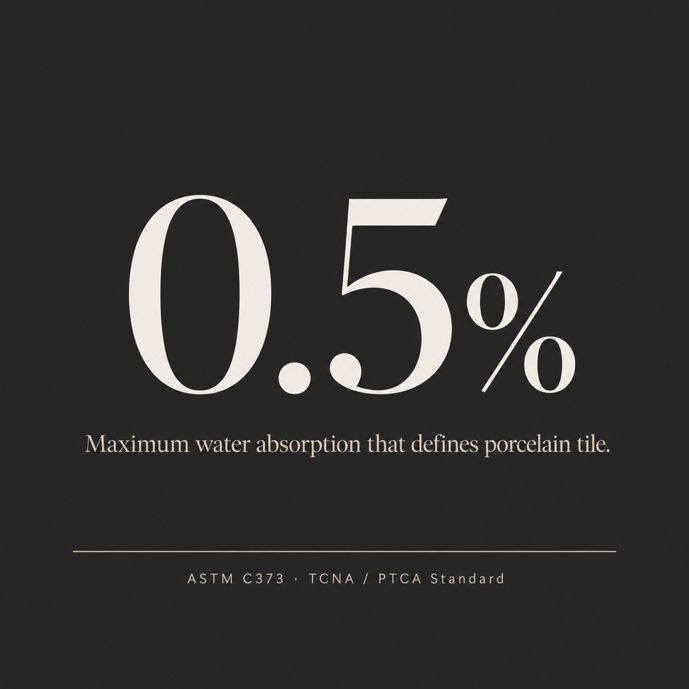
Porcelain is a manufactured ceramic. It's made from clays, feldspar, and sand, pressed under high pressure and fired at 1,180 to 1,220°C. The result is a dense, vitreous tile with very low porosity and consistent physical properties from piece to piece. The Tile Council of North America (TCNA) requires that porcelain tile absorb no more than 0.5% of its weight in water, measured by ASTM C373. That low absorption rate is what defines porcelain and drives most of its practical advantages in wet and outdoor applications.

Natural stone is quarried from the earth. Marble, granite, travertine, limestone, slate, quartzite, and onyx are all natural stone, but their physical properties vary enormously. Granite absorbs very little water (typically 0.05% to 0.40%, according to the Natural Stone Institute) and ranks among the hardest dimension stones available. Limestone and travertine, by contrast, are calcium-carbonate-based, absorb significantly more water (ranging from less than 1% to over 10%), and are vulnerable to mild acids like lemon juice and vinegar. Every slab and tile is geologically unique. That's part of the appeal, but it also means performance varies by stone family, quarry, and even individual batch.
Porcelain gives you factory-certified consistency. Natural stone gives you geology you can't replicate. Both have real strengths, but those strengths show up in different rooms and conditions.
Water Resistance
Porcelain's 0.5%-or-lower absorption rate makes it one of the most water-resistant hard surfaces available. Glazed porcelain is essentially impervious to water on the surface, which is why it dominates in showers, bathroom floors, and pool surrounds where sustained water contact is a given.
Natural stone's water resistance depends entirely on which stone you're talking about. Granite is very water-resistant, with absorption rates comparable to some porcelains. Quartzite is similarly dense. But limestone, travertine, and many marbles are more porous and will absorb moisture if left unsealed, which can lead to staining, mineral deposits, and eventually structural weakening.
Something worth noting is that in a wet installation like a shower or pool, the waterproofing comes from the assembly, not just the tile surface. TCNA's recommended shower methods call for a waterproof membrane beneath the tiled surface. The tile is the wear layer; the membrane keeps water out of the wall or floor structure. This applies to both porcelain and stone.
Durability, Hardness, and Strength
Porcelain tile has a defined minimum breaking strength of 250 lbf (1,112 N) under ASTM C648. Because it's factory-made, every tile that leaves the production line meets that threshold. Scratch resistance is generally high, though the specific Mohs hardness varies by product, glaze, and finish. ASTM C1895 governs Mohs scratch-hardness testing for ceramic tile, but there's no single universal "porcelain is Mohs X" number. Product-specific testing determines the actual value.
Natural stone durability is a spectrum:
Granite and quartzite are the stone families that most closely rival porcelain for everyday wear. Granite's mineral composition (feldspar at Mohs 6, quartz at Mohs 7) gives it strong scratch resistance, and its low absorption makes it a durable floor and countertop material.
Marble is softer (calcite is Mohs 3) and more chemically reactive. It will etch from acidic spills and scratch more easily than granite. Marble earns a patina over time, and that patina is either part of the appeal or a maintenance headache, depending on the homeowner.
Limestone, travertine, and slate each bring different strengths. Travertine is prized for its warmth and texture but needs regular sealing. Slate varies in hardness. Limestone is softer and more porous than granite.
The simplest way to think about it: porcelain offers predictable, factory-certified durability across the board. Natural stone can match or exceed porcelain on hardness (granite and quartzite are extremely hard), but performance swings much more by stone family and source.
Maintenance
Porcelain is usually the lower-maintenance choice. Glazed porcelain doesn't need sealing. Routine cleaning often requires nothing more than water, or a pH-neutral cleaner for deeper cleaning. Some unglazed or polished porcelains may benefit from a sealer, since the finishing process can open surface pores. But for most glazed porcelain floors and walls, the care routine is simple: wipe, mop, done. Grout lines still need attention regardless of tile material, and porcelain sealing and maintenance guidance from TileLetter is worth reading if you're choosing an unglazed or polished finish. For a deeper look at cleaning routines by material type, our tile care and maintenance hub covers the specifics.

Natural stone requires more intentional care. The Natural Stone Institute recommends cleaning with neutral cleaners, stone soap, or mild liquid dish soap, and warns against products containing lemon, vinegar, or other acids, which can dull or etch calcareous stones like marble and travertine. Stone "sealers" are really impregnators: they improve stain resistance, but they don't make stone waterproof or stain-proof. Most stone surfaces need resealing every one to three years depending on the stone type and how much wear the surface sees.
Factor | Porcelain | Natural Stone |
Sealing required? | No (glazed); sometimes (unglazed/polished) | Yes, and needs periodic resealing |
Cleaning products | Water or pH-neutral cleaner | Neutral cleaners only; no acids |
Acid sensitivity | None | High for marble, limestone, travertine |
Grout maintenance | Same for both | Same for both |
Long-term upkeep effort | Low | Moderate to high, depending on stone type |
How Each Material Handles Cold and Freeze-Thaw Cycling
For outdoor installations in climates that see freezing temperatures, this is one of the most consequential factors in the decision.
Porcelain has the stronger standards-backed case. Its very low water absorption (0.5% or less) means there's very little moisture inside the tile body to expand during a freeze cycle. ASTM C1026 is the standard freeze-thaw test for ceramic tile, and TCNA's frost resistance guidance notes that tiles meeting this standard and rated for exterior use generally perform well when installed by accepted methods. That said, TCNA also warns that even frost-resistant tile can be damaged if water pools on the installation or infiltrates the setting bed through grout joints. Frost-resistant tile does not automatically mean a frost-proof installation.
Natural stone's freeze-thaw performance varies dramatically by type and porosity. Low-porosity stones like granite and quartzite handle freeze-thaw conditions well. Higher-porosity varieties, particularly some limestones and travertines (with absorption rates that can exceed 10%), are riskier for outdoor paving in cold climates. Peer-reviewed research has found that natural stones with open porosity above 2% are generally not advisable for freeze-thaw exposure because of accelerated strength loss over repeated cycles.
For outdoor projects, exterior-rated porcelain (like our Sinai porcelain collection, rated R11 for slip resistance and designed for outdoor applications) is the safer default in cold climates. Natural stone can work well outdoors, but the specific stone variety needs to match the climate and drainage conditions, and the installer needs to understand exterior stone assemblies.
Cost of porcelain tile vs. natural stone
Cost is where most comparisons get muddy, because material price and installed price tell very different stories. These figures are general market estimates, not Bedrosians' own pricing. Actual costs vary by region, material, finish, and project conditions, and pricing differs from showroom to showroom. Here's each kept separate, using current neutral cost data.
Cost basis | Porcelain tile | Natural stone |
Material only | About $0.50 to $15 per square foot indoors; higher for outdoor-rated lines | About $4 to $18 per square foot; marble and rare stone climb well above |
Installed (material plus labor) | Roughly $9 to $50 per square foot | Roughly $10 to $35 per square foot |
Sources: Angi porcelain cost data and Angi natural stone cost data, 2026.
Two things stand out in those ranges. First, porcelain is generally the more affordable and more predictable material, especially for standard indoor products, because it's factory-produced at scale. Natural stone is more of an investment: the material itself spans a huge price band, and the upkeep continues after installation.
Second, the ranges overlap once labor enters the picture. Outdoor-rated porcelain, premium looks, and prep work can push an installed porcelain floor into the same territory as a lower-end stone install. Stone usually costs more on average (driven by quarry-to-jobsite logistics, harder fabrication, and more installation skill), but porcelain isn't automatically the cheaper option once labor is counted.
Which Material Works Best in Each Room
Kitchen Floors and Backsplashes
Porcelain is the easier practical choice for kitchen floors. It handles spills, dropped utensils, and heavy foot traffic without staining, etching, or scratching. No sealing schedule, simple cleanup.
Granite competes most directly here among natural stones. Low absorption and strong scratch resistance (thanks to its feldspar and quartz content) make granite a legitimate kitchen-floor and countertop material. The Natural Stone Institute rates granite's heat resistance at approximately ±250°C (±480°F), which matters near stovetops or ovens.

Marble, limestone, and travertine on kitchen floors require more attention. Any acidic spill (wine, citrus, tomato sauce) can etch the surface, and the stone will need regular sealing. These materials tend to work better as backsplashes or in spaces where the homeowner values the look enough to manage the upkeep.
Bathrooms and Showers
Porcelain is the most common choice for shower walls and floors. Near-zero absorption, easy cleaning, and compatibility with standard waterproof membrane systems make it the simplest path for wet areas.
Natural stone can look beautiful in bathrooms, but it demands more careful product selection. Polished stone surfaces can be slippery when wet (check the tile's DCOF rating for slip resistance). Stone cleaners must be non-acidic to avoid etching. And the stone will need regular sealing to maintain stain resistance in a high-humidity environment.
For homeowners who want the stone look with porcelain performance, many of our porcelain collections replicate the appearance of marble, travertine, and other natural stones with realistic veining, color variation, and texture.
Outdoor Patios and Pool Decks
Exterior-rated porcelain is the stronger default for outdoor installations, especially in climates with freeze-thaw cycles. Our Sinai porcelain collection is rated R11 for anti-slip performance and approved for poolside, patio, and outdoor stair use.
Natural stone works outdoors when matched to the conditions. Granite and quartzite handle weathering well. Limestone and travertine are riskier in cold climates because of their higher porosity. If you're considering stone for an outdoor project, confirm the specific variety's absorption rate and freeze-thaw suitability with your supplier before committing.
Subfloor and drainage matter more outdoors than in any other application. Even the most frost-resistant tile can fail if water pools on the surface or infiltrates the setting bed. Proper slope, drainage, and installation methods are non-negotiable regardless of the material.
Countertops and Slabs
For countertops, the comparison shifts to slabs. Porcelain countertop slabs (like our Magnifica porcelain slab line, the first 2cm porcelain slab manufactured in the United States) offer a dense, low-maintenance surface that resists staining and never needs sealing. Edge detailing and installation quality matter more than most homeowners realize, since porcelain slabs are harder to cut and fabricate on-site than many natural stones.
Granite remains one of the most popular natural stone countertop choices. Low absorption, strong scratch resistance, and genuine heat resistance make it a practical kitchen surface. For homeowners who visit one of our slab yards, each granite slab is geologically unique, so you can hand-select the exact veining and coloring for your kitchen.
Marble countertops are the most care-intensive option. They will etch, they will patina, and they will need regular sealing. Many homeowners choose marble knowing this, and consider the character part of the appeal. Others find the maintenance frustrating. Know which camp you're in before you commit.
How to Decide: A Quick Framework
If your priority is... | Consider porcelain | Consider natural stone |
Low maintenance | Yes, strongly | Only granite or quartzite |
Predictable performance | Yes | Less so; varies by stone |
Wet-area reliability | Yes | Works with careful product selection |
Freeze-thaw outdoor use | Yes (exterior-rated) | Only low-porosity stones |
Budget-friendly mid-range | Yes | Possible with travertine/slate |
One-of-a-kind natural appearance | Porcelain can replicate the look | Yes, strongly |
Patina and character over time | No; porcelain stays as-installed | Yes, especially marble |
Heat resistance for countertops | Good | Granite is excellent |
Frequently Asked Questions
Is porcelain tile cheaper than natural stone?
Usually, at the material level. Standard indoor porcelain starts as low as $0.50 per square foot, while most natural stone starts around $4. But the ranges overlap: premium porcelain can exceed $30 per square foot, and some stone varieties (like basic travertine) can be surprisingly affordable. Installed costs overlap even more once labor, transportation, and fabrication are factored in.
Can natural stone go in a shower?
Yes, but it takes more planning than porcelain. The stone should be sealed before installation and resealed periodically, and the installer needs to use a waterproof membrane system per TCNA recommendations. Avoid highly polished finishes on shower floors (slippery when wet), and use only non-acidic cleaners. Granite and quartzite are the safest stone choices for showers; marble and limestone need more attentive care.
Does porcelain tile crack in cold weather?
Exterior-rated porcelain that meets ASTM C1026 freeze-thaw testing standards is designed for cold-climate outdoor use. But "frost-resistant" refers to the tile itself, not the installation. Porcelain can still fail outdoors if water infiltrates the setting bed, pools on the surface, or freezes in grout joints. Proper installation with adequate slope and drainage is essential.
Which is better for resale value?
Both materials hold value well, but in different ways. Porcelain floors in kitchens, bathrooms, and entryways are broadly appealing to buyers because they're low-maintenance and durable. Natural stone (especially granite countertops and marble features) can command a premium in higher-end markets where buyers expect those materials. The best choice for resale depends on the price point and style expectations of your local market.
See Both Materials Before You Decide
The best way to compare porcelain and natural stone is to hold them side by side. Order samples online ($1 per sample, or 5 free with code SHIPFREE5 on your first sample order) to see how each material reads in your actual lighting and alongside your finishes. Or visit any of our 44 showrooms across 11 states, where our sales specialists can walk you through the options for your specific project.
Call (559) 275-5000 to reach the right showroom, or browse our full porcelain and stone collections at bedrosians.com.
