How to Create a Mediterranean-Inspired Bathroom with Tile
June 15, 2026
A Mediterranean-inspired bathroom comes from a short list of concrete choices: a warm, earthy color palette, handmade-look zellige on the walls, Moroccan cement-look pattern on the floor or a feature wall, terracotta tones underfoot, and natural stone like travertine or marble for contrast. Get those levers right and the room reads as authentically Mediterranean instead of themed. At Bedrosians Tile & Stone, we design collections like Zagora zellige in-house, which is part of why the exact materials this look calls for sit under one roof, and after 78 years as a family-owned tile and stone company, we have a clear view of which of them belong on the floor, on the wall, and inside the shower.
The one place this style trips people up is water. Terracotta is the signature Mediterranean floor, but raw terracotta is porous, so where it goes and how it is finished matters. We get into that below, along with the tiles that create each part of the look and where each one belongs.
Start with the Mediterranean color palette

A Mediterranean bathroom is built on a warm, earthy base, then punctuated with a few saturated accents borrowed from the water.
Earthy base: ochre, sand, unbleached linen, and raw terracotta. These warm tones absorb and soften natural light instead of bouncing it back the way stark white tile does, which is what gives the room its sun-baked calm.
Jewel-tone accents: oceanic blue, turquoise, emerald green, or oxidized copper. Keep bold color to one zone, like a shower interior, a niche, or a single feature wall, so it reads as intentional rather than busy.
The whole effect comes from that pairing, warm earth against deep water, the same contrast you see along the coast itself.
The signature tiles that create the look
A handful of materials carry this style, and each one has a place it belongs and a place it does not. The plan matters as much as the choice.
Zagora zellige for walls and shower surrounds
Zagora zellige is the most recognizable Mediterranean material, and the one that does the most to sell the look. Zellige is traditional Moroccan tile made from unrefined clay that is hand-molded, sun-dried, kiln-fired, and finished with a mineral glaze. Because traditional kilns heat unevenly, each piece warps a little and takes the glaze differently, so no two tiles are identical. That irregular, undulating surface catches and scatters light like moving water, which is exactly the effect you want on a wall.
Put zellige where it can catch light and stay out of standing water, like shower walls, vanity backsplashes, and the inside of a niche. In a bathroom, it belongs on the walls and out of the shower floor, for reasons we get into below. Designer Nicole Salceda of Eye for Pretty used Zagora zellige in Blanc on the Horton Hotel project, which is a good example of the material carrying a room. Our zellige collection shows the full run of colorways, and we told the story behind the line when we introduced Zagora.
Casablanca and cement-look pattern for floors and feature walls
For the graphic, patterned element of the style, reach for a cement-encaustic look. Our Casablanca ceramic carries the Moorish and azulejo-style motifs of traditional Moroccan cement tile, reading like a permanent, tiled rug. True encaustic cement tile builds its pattern from inlaid pigment roughly 1/8 inch deep, so the design wears in rather than off. A ceramic version like Casablanca gives you that patterned look with a more practical, lower-maintenance surface.
Use patterns with restraint. The most reliable move is to clad the floor in pattern and leave the walls quiet, or reserve the pattern for one feature like a niche or a vanity wall. Pattern on every surface tips the room into costume. For patterned options, our encaustic-look tile range is the place to start.
Terracotta and terracotta-look tile for warm floors
Terracotta, which means baked earth, is the floor that grounds the whole style. Its warm, iron-rich clay color is the genre's signature neutral, and its naturally textured surface gives good grip underfoot. The catch is water. Natural, unglazed terracotta is porous, which changes where and how you can use it. We break that down in the next section, because it is the question this style raises most often.
For the warm terracotta look without the water worry, a terracotta-look porcelain is the practical answer, and it reads convincingly at floor scale. A terracotta-look line like Makoto brings that baked-clay warmth in an extended format. You can compare formats across our full floor tile range.
Travertine and marble for natural stone accents
Natural stone is what separates an authentic Mediterranean bathroom from a themed one. Travertine, a limestone laid down by mineral springs, has natural pitting and a soft, weathered texture that suits the style perfectly. In a honed or tumbled finish, it also gives you slip resistance, which makes it a strong floor and wainscot choice. Heavily veined marble adds a more formal note as a vanity top, a shower curb, or an integrated sink.
One planning note on marble. Real marble etches when it meets acidic products, which are common in a bathroom. Where you want the marble look in a high-splash zone, a marble-look porcelain holds up without sealing or etching. Our natural stone tile selection covers travertine, and our marble tile range carries natural marble, with a marble-look porcelain available when you want the veining without the etching risk.
Mosaics for niches, borders, and shower floors
Mosaics are the workhorse detail of the style. Small-format mosaics in glass, stone, or porcelain are ideal for a shower niche, a border, or a floor accent, and they earn their place on the shower floor for a practical reason. A dense grid of small tiles means a dense grid of grout joints, and those joints give the foot real traction where a larger, smoother tile might feel slick when wet. The small formats in our mosaic tile range are the ones that work best on a shower pan.
Cloe for a simpler, whitewashed look
Not every Mediterranean bathroom leans Moroccan. For the quieter, whitewashed Spanish or coastal version of the style, a glossy handmade-look ceramic does the job. Our Cloe ceramic is a curved-square glaze with gentle light play, which gives a wall that handcrafted feel without strong pattern or heavy color. It pairs well with a terracotta or stone floor when you want the room to feel calm.
Can you use terracotta in a bathroom?
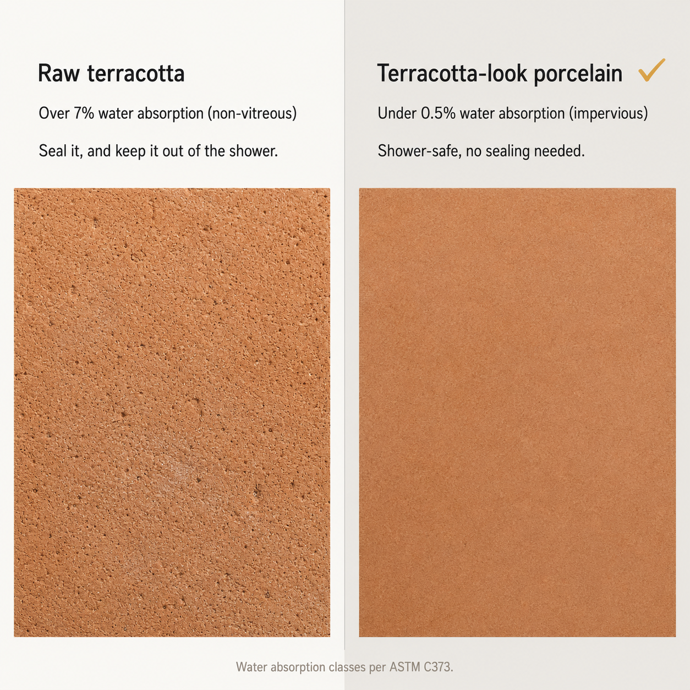
Yes, but placement and finish decide whether it lasts. The confusion comes from terracotta's porosity, and the fix is understanding how much water a tile absorbs and where that lets it go.
Water absorption is measured under the ASTM C373 standard, and the tile industry sorts the results into four classes. Impervious tile absorbs 0.5% or less, and non-vitreous tile absorbs more than 7%. Unglazed, handcrafted terracotta is non-vitreous. It is fired at relatively low temperatures, so the clay never fully vitrifies, and the body stays porous enough to draw in and hold water.
Where that matters depends on how wet the surface gets. The Ceramic Tile Education Foundation splits bathroom surfaces into limited-water areas and true wet areas, and it is a useful line to hold. General bathroom floors outside the shower count as limited-water. Shower floors and shower walls are wet areas, soaked and saturated regularly.
On a general bathroom floor, natural terracotta works well if it is sealed properly. That means a penetrating, impregnating sealer, applied before grouting and in several coats after, until the surface stops drinking water. Skip film-forming topical sealers in a bathroom, because trapped moisture makes them cloud and peel.
Inside the shower, we steer homeowners away from raw, unsealed terracotta. In a constantly wet enclosure, water passes through the porous body, and dissolved salts from the mortar below get carried back to the surface, where they dry into a chalky white haze called efflorescence. The tile itself can also degrade over time as absorbed water expands and contracts.
The clean solution is terracotta-look porcelain in the shower. Porcelain is impervious, under 0.5% absorption, and modern printing reproduces terracotta's tonal variation and matte warmth convincingly. Many designers run authentic terracotta on the main bathroom floor and terracotta-look porcelain inside the shower, which gets the look everywhere and the performance where it counts. If you are weighing materials for a full remodel, our guide to choosing between porcelain, ceramic, and stone goes deeper.
Where each tile goes in the bathroom

Once you have the materials, the plan is mostly about matching each one to the right surface. Here is how the signature Mediterranean tiles map to a bathroom.
Surface | Best-fit materials | Why it works |
Main bathroom floor | Sealed terracotta, terracotta-look porcelain, cement-look pattern, honed or tumbled travertine | Warm and grounding, with slip resistance when the finish is matte or textured |
Shower floor | Small-format mosaics, 2×2 inch or smaller | Dense grout joints add traction on a wet, soapy surface |
Shower walls | Zagora zellige, terracotta-look or stone-look porcelain, glazed jewel-tone tile | Light-catching or impervious surfaces over a properly waterproofed wall |
Vanity backsplash and niches | Zellige, glass or stone mosaic, patterned accent | Small, high-impact zones for texture or color |
Vanity top and curb | Marble, marble-look porcelain, travertine | A formal stone note; marble-look resists etching in splash zones |
Feature wall | Casablanca cement-look pattern, jewel-tone zellige | One concentrated dose of pattern or color |
Slip resistance is the hard rule for anything on the floor. The industry measures it with the dynamic coefficient of friction, and the standard, ANSI A326.3, sets a minimum wet DCOF of 0.42 for interior floors that get walked on wet. Polished marble and high-gloss glazes usually fall short of that when wet, which is another reason glossy zellige and polished stone belong on walls. Honed, tumbled, and textured surfaces clear it comfortably.
One thing tile cannot do is waterproof the wall behind it. In a shower, the tile is the wear layer, and a separate bonded waterproofing membrane behind it does the real work of keeping moisture out of the framing. This matters most with handmade zellige, where the uneven surface offers no defense of its own, so the substrate has to be flat and properly waterproofed first. We supply the tile and the setting materials, and a qualified installer handles the waterproofing and the set. If you are choosing surfaces for the wet zone, our shower tile selection is a good place to start.
Getting the grout, pattern, and layout right

Grout color matters more than people expect. Bright white grout against earthy tile draws a hard grid around every piece and breaks the handmade illusion. A warm sand, beige, or cream grout softens the seams and lets the surface read as one continuous, old-world plane. Match the grout to the dominant tone of the tile.
Zellige needs a real grout joint, even though the traditional look is edge-to-edge. Because handmade zellige varies so much in size, butting the tiles tight leads to cracked glazes and water intrusion in a modern wall. A minimal joint of 1/16 to 1/8 inch, with an unsanded grout color-matched to the glaze, gives you the near-seamless look while leaving room for movement. Tile Council of North America grout guidance backs this approach for hand-molded tile.
For large terracotta or wood-look planks, stagger the layout no more than a third, not the classic half-brick offset. Long tiles bow slightly in the kiln, and a 50% offset lines up the high center of one plank with the low edge of the next, which creates lippage and an uneven floor. A one-third stagger keeps the surface flat.
Frequently asked questions

Can you use zellige tile on a shower wall?
Yes. Zellige works well on a shower wall as long as the wall behind it is flat and properly waterproofed. Keep zellige off the shower floor, where its uneven surface is both a slip and a pooling risk.
What is the best tile for a Mediterranean bathroom floor?
Sealed natural terracotta, terracotta-look porcelain, cement-look pattern, or honed travertine. Choose a matte or textured finish so the floor meets the 0.42 wet DCOF slip standard.
Do you need to seal terracotta tile in a bathroom?
Natural, unglazed terracotta needs a penetrating sealer applied before grouting and in several coats after. Terracotta-look porcelain needs no sealing, which is why it is the easier choice inside a shower.
Bring the look into your own bathroom
The fastest way to know whether a warm glaze or a terracotta tone is right is to see it in your own bathroom light. Order $1 samples, or five free with the code SHIPFREE5, so you can hold the real tile before you commit, and use our Room Visualizer to preview a look in your space. If you would rather see zellige and stone in person, we have 44 showrooms across 11 states where you can compare finishes side by side. When you are ready to plan the room, start with our bathroom tile collection, or tell us what you are working on and we will help you build the look.

