Large Format Tile for Showers: Ideas and Installation Tips (2026)
July 31, 2026
Large format tile works beautifully in showers, and it does its best work on the walls, where fewer grout lines create a cleaner, more continuous surface that is easier to wipe down and makes even a small shower feel more open. The one part to plan carefully is the floor, which usually calls for smaller tile or mosaic so it can slope to the drain and hold traction underfoot. At Bedrosians, we have spent 78 years helping homeowners, designers, and contractors plan tile projects across our 44 showrooms in 11 states, and large format has become one of the most requested looks we see for showers.
This guide covers both sides of the project. First the design ideas that make a large format shower work, then the installation details worth understanding before the first tile goes up.
What counts as a large format tile?
In the tile trade, "large format" has a specific meaning. Once a tile has at least one edge measuring 15 inches or longer, stricter installation rules kick in for how flat the wall has to be and how the tile can be laid out. The most common large format sizes you will see specified for showers are 12×24, 24×24, and 24×48.
Large format tile comes in several materials, and they do not all behave the same way in a wet area:
Porcelain is the usual default for showers. It is a dense ceramic defined by water absorption of 0.5% or less, which is why it holds up so well against constant moisture. Our porcelain tile selection is the deepest part of our catalog for this reason.
Porcelain slabs and panels are a step up in scale. These very large pieces are governed by their own set of standards and installation methods, and they are usually a job for an experienced installer. Our Magnifica porcelain slab line reaches sizes up to 120×60 in 12mm and 2cm thicknesses and carries GreenGuard certification, which makes it the natural choice for a seamless, minimal-grout shower wall.
Natural stone such as marble and travertine is a gorgeous option, but it is porous and needs sealing, careful detailing, and ongoing maintenance in a shower.
Glass carries a specific caution. Large glass tiles can be sensitive to thermal shock when cool glass meets hot water and steam, so it needs product-specific approval before it goes in a shower.
You can browse the full range of oversized options on our large format tile page.
Why large format tile works in showers
The Tile Council of North America attributes large format tile's popularity partly to less overall grout area, and that translates into a few real advantages for a shower:
Fewer grout lines. Larger pieces cover more surface with fewer joints, which means less grout to seal, scrub, and watch for discoloration over time.
Easier cleaning. A smooth tile face is simpler to wipe down than a grid of grout lines, so day-to-day maintenance gets lighter.
A greater sense of space. Fewer visual breaks make a wall read as one continuous surface, and that calmer, less busy look tends to make a bathroom feel larger.
This is also why large format can work well in a small shower. The benefit shows up most on the walls, where a continuous surface opens the space up, rather than on the floor, which still needs slope and grip no matter how big the tile is.
Large format tile shower ideas
Here are the looks and layouts that hold up best in a shower.
Layout patterns
The three layouts most people recognize are stacked, running bond, and herringbone.
Stacked (grid). Tiles line up in a clean grid, either vertical or horizontal. Vertical stacking draws the eye up and can make a shower feel taller. This is the calmest, most modern option.
Running bond (offset). Each row shifts relative to the one above it, like a brick wall. It reads as classic and relaxed.
Herringbone. Rectangular tiles set at angles for a more tailored, textural look.

Running bond has one catch with long tiles. Once the offset side of a tile is longer than 15 inches, industry guidance caps the offset at 33% unless the manufacturer approves more and a mock-up is done. In plain terms, a big rectangular tile should not be laid in a dramatic halfway-brick offset, because the natural warpage in long tiles causes lippage (uneven edges) when they are staggered too far. A gentle offset or a straight stack is the safer call.
Material looks
Marble-look porcelain. This is the look that dominates the category. It gives you the veining and light of natural marble with the low-maintenance durability of porcelain. Our Allora porcelain is a marble-look collection built for exactly this kind of application.
Concrete and cement looks. A soft, matte, minimal aesthetic that suits modern and spa-style bathrooms. Our Opus porcelain, a 24×48 tile with a chiseled texture, is a genuine large format option in this direction.
Natural stone. Marble, travertine, and limestone bring warmth and one-of-a-kind veining, with the sealing and care considerations noted above.
Wood-look planks. These extend the plank look up a shower wall, though they run long and fall squarely under the offset and warpage rules, so layout planning matters.
Tile drenching
Tile drenching means carrying one tile across multiple surfaces, most often from wall to wall, and where the design and slope allow, from floor to wall. The effect is seamless and enveloping, and it reads as high-end while keeping the material palette simple. A large format marble-look or concrete-look porcelain is a natural fit for a drenched shower because the continuous surface is the whole point.
Feature and accent walls
If drenching the whole shower feels like too much, a single feature wall gives you the same drama in a smaller dose. Run a bold marble-look or a textured concrete-look tile on the back wall of the shower, then keep the side walls simple. The large format scale keeps a feature wall looking intentional and clean rather than busy, and it draws the eye to one focal point as you walk in.
Large format walls with a mosaic floor and niche
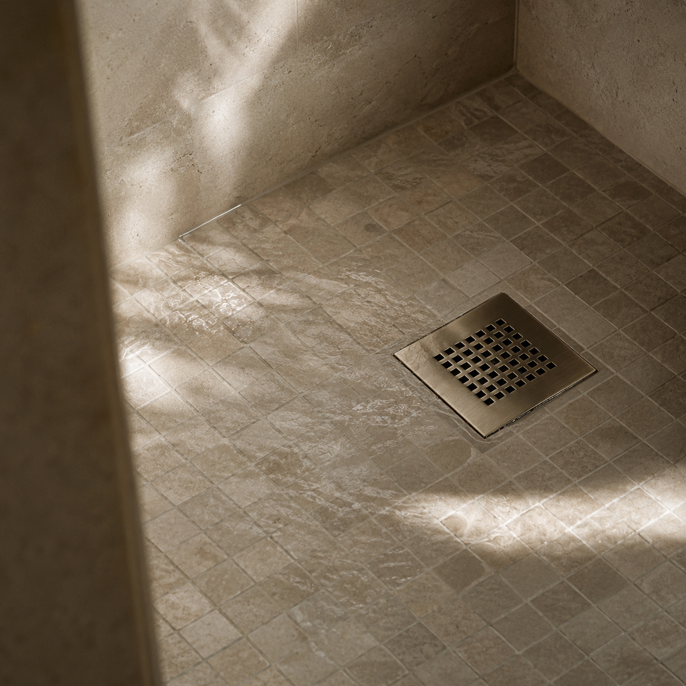
The smartest and most common move in a well-designed shower is to pair large format tile on the walls with smaller tile or mosaic on the floor, then echo that smaller format inside the niche. This respects what each surface needs. The walls get the clean, continuous look, and the floor gets the traction and drainage-friendly grout lines it requires. Our mosaic selection is a good place to find a floor and niche tile that complements a large format wall.
Large format tile on shower walls vs. shower floors
Walls and floors ask for different things, and this is the distinction most inspiration galleries skip.
Surface | Best choice | Why |
|---|---|---|
Shower walls | Large format tile | Fewer grout lines, a continuous look, and a greater sense of space |
Shower floor | Smaller tile or mosaic | More grout lines add traction, and small pieces follow the slope to the drain |
A standard shower floor has to slope to the drain from every direction, and smaller tiles flex to follow that slope while their extra grout lines add grip underfoot. There is one notable exception. A linear drain lets the floor slope on a single plane, which makes larger floor tile much more workable. So the honest rule is that most shower floors still work best with smaller tile or mosaic, unless the drain and slope are specifically designed for large format.
You can see wall and floor options together on our shower tile page.
Large format tile shower installation tips
We do not install tile ourselves. Our showroom teams help you choose the right tile and setting materials, then point you to a qualified local installer. The section below is meant to help you understand what a good install involves and what to ask your installer, whether you are hiring out the work or considering some of it yourself.
Substrate prep and flatness

Large format tile is far less forgiving of a wavy wall than smaller tile. Once a tile crosses the 15-inch threshold, the substrate has to be flat within 1/8 inch over 10 feet and 1/16 inch over 2 feet. Smaller tile allows roughly twice that variation. A wall that is only "pretty good" will show every high and low spot as lippage once big tiles go up, so flattening the substrate first is one of the most important steps in the whole job.
Waterproofing
Tile and grout are not a waterproof layer on their own. Water will migrate through them over time, so a shower needs a proper waterproofing membrane behind the tile, installed to standard. Bigger tiles and fewer grout joints do not change this. Waterproofing membranes are exactly the kind of product our pro counters stock, including systems from partners like Laticrete and Custom Building Products, alongside the thinset, grout, and sealers a shower install needs.
The right mortar

Large and heavy tile calls for a mortar designed to support it. The current term is large-and-heavy-tile mortar (it replaced the older "medium bed" label). This mortar is formulated to hold a big tile in place without sagging under its own weight and to help control lippage. It will not fix a bad wall, though, and it is not meant to flatten or true an out-of-tolerance substrate, which loops back to why flatness prep comes first.
In a shower, industry standards call for 95% mortar coverage behind the tile, with full support at the corners and edges. Achieving that on large tile usually means back-buttering each piece (spreading mortar on the back of the tile) in addition to combing it onto the wall. Voids behind tile in a wet area can trap water and cause staining and bond problems later.
Lippage, grout joints, and offset
Two layout rules protect the finished look. First, keep any running bond offset to 33% or less for tiles longer than 15 inches. Second, the grout joint should be wide enough to absorb the tile's natural warpage. Trade guidance sets a minimum average joint of about 1/8 inch for rectified tile and 3/16 inch for calibrated tile in a running bond, then adds to that based on the actual warpage of the tile. This is why a hairline grout joint on a long large format tile is a recipe for visible lippage.
Movement joints
Corners and changes of plane need movement joints, sometimes called soft joints. Rather than hard-grouting a shower's inside corners and the floor-to-wall transition, an installer fills those spots with a flexible sealant so the assembly can move slightly without cracking. Plenty of inspiration photos show hard-grouted corners, but that is not best practice.
Slip resistance on the floor
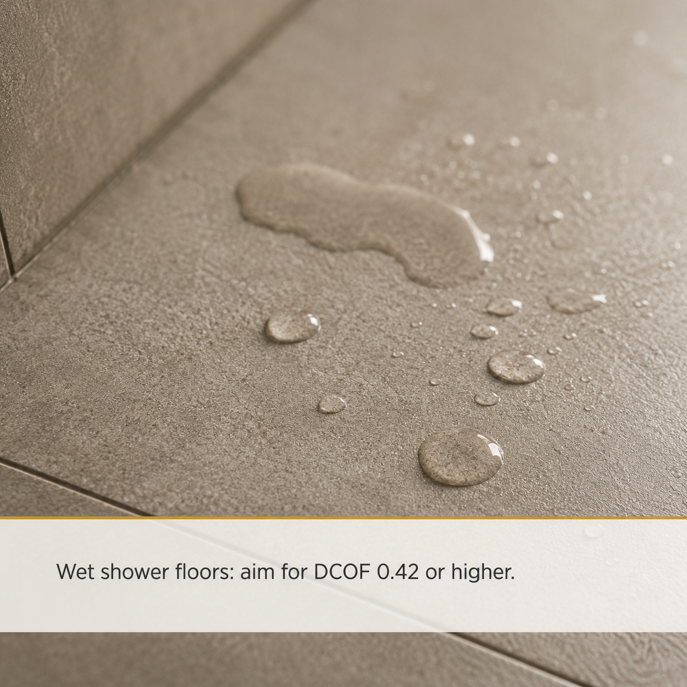
For a floor that will be walked on wet, the benchmark is a DCOF of 0.42 or higher. DCOF (dynamic coefficient of friction) measures how much grip a surface offers when wet, though it does not fully predict whether someone will slip, especially on a sloped shower floor. This is another reason smaller floor tile and its extra grout lines are the standard recommendation. If you want to go deeper on choosing a safe wet-area tile, our guide on understanding DCOF breaks it down.
Should you DIY or hire a professional?
A confident DIYer with tiling experience may be able to handle some large format wall work, particularly on a well-prepped, already-waterproofed wall. The reason large format shower work leans toward professional installation is that it stacks several specialized skills at the same time. Substrate flattening, waterproofing, mortar coverage on heavy tile, lippage and warpage management, and movement-joint detailing all have to be right at once, and the tiles themselves are heavy and awkward to handle. Full porcelain slabs and panels are firmly in professional territory. When waterproofing, the shower floor, or slabs enter the picture, working with a qualified installer is the prudent choice, and your showroom can refer you to trusted local contractors.
Large format tile shower FAQ
Can you use large format tile in a small shower?
Yes. Large format tile can make a small shower feel more open because fewer grout lines create a continuous surface. The benefit is strongest on the walls. The floor still works best with smaller tile or mosaic for slope and grip.
What size tile is best for a shower floor?
Smaller tile or mosaic is usually best for a shower floor because the extra grout lines add traction and the small pieces follow the floor's slope to the drain. Large format floor tile can work when a linear drain allows a single-plane slope.
Do large format tiles need special mortar?
Yes. Large and heavy tile needs a large-and-heavy-tile mortar that supports the weight without sagging and helps control lippage. Standard thin-set is not always sufficient, and the mortar is not a substitute for flattening the wall first.
Is large format tile harder to install than regular tile?
Generally yes. Large format tile requires a flatter substrate, careful mortar coverage, and precise layout to avoid lippage, and the pieces are heavier to handle. Most large format shower installs benefit from an experienced installer.
Ready to plan your large format shower?
The best way to choose large format tile for a shower is to see it in person and hold it in your hand, because scale, finish, and color all read differently at full size. Order tile samples to test your options in your own light, or stop by one of our showrooms, where our design specialists can walk you through layouts, materials, and the setting materials your installer will need. When you are ready to talk through your project, reach out to our team and we will help you get it right from the wall down to the drain.

