Marble vs. Marble-Look Porcelain: How to Decide
August 7, 2026
Choosing between marble and marble-look porcelain comes down to your room and how you live in it. There is no universal winner between the two. They can look nearly identical, but they behave differently once installed. The better choice depends on how much traffic and moisture the surface will see, how much upkeep you are willing to do, and how much the authenticity of real stone matters to you. This guide walks through the factors that actually decide it, so you can match the material to your project. At Bedrosians Tile & Stone, we have spent 78 years selling both genuine marble and marble-look porcelain across 44 showrooms in 11 states, so we have no reason to steer you toward one over the other. We would rather you pick the surface that fits your space.
One note on pricing before we get into it. The dollar figures in this guide are general market estimates. Actual costs vary by region, the specific stone or tile you choose, site conditions, and the size of the project. Use the ranges to plan a budget, then get a quote for numbers specific to your job. If you want the broader picture of natural stone versus porcelain across all stone types, we cover that separately in our guide to porcelain vs. natural stone. This article stays focused on the marble decision specifically.
What is the difference between marble and marble-look porcelain?
The biggest difference between them comes down to what they are made of.
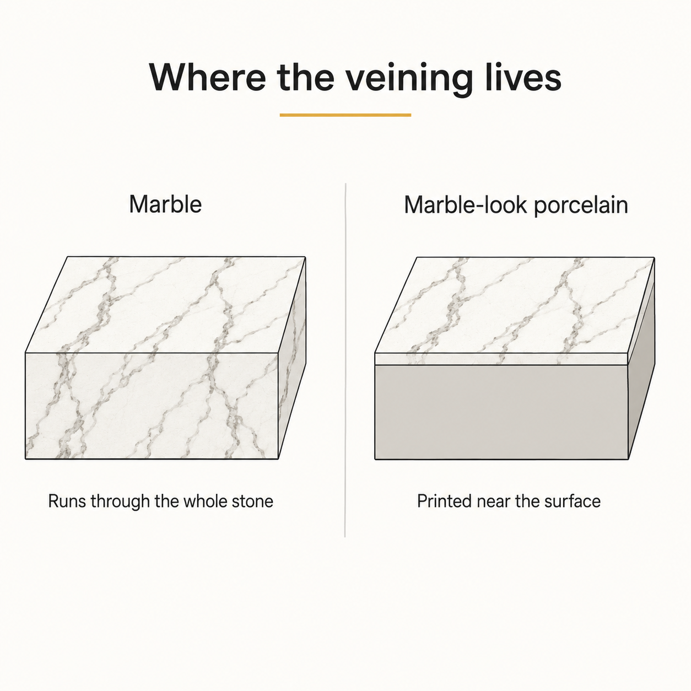
Marble is a natural stone. It forms when limestone recrystallizes under heat and pressure, and its color and veining come from that geologic process. Because it is a natural material, every slab is one of a kind, and the veining runs through the full thickness of the stone rather than sitting on the surface. Marble is also relatively soft, with a hardness less than glass, which is part of why it can scratch and etch more easily than a hard tile.
Marble-look porcelain is a manufactured ceramic tile. It is made from refined clays and minerals, pressed under high pressure, and fired at high temperature until the body becomes dense and moisture-resistant. The tile industry defines porcelain by a specific number: a water absorption rate of 0.5% or less, certified by the Tile Council of North America. The marble appearance is created with high-definition digital printing applied during manufacturing.
It comes down to authenticity. Real marble tile is genuine stone all the way through. Marble-look porcelain tile is an engineered reproduction of that look. Neither of those facts makes one better. They just point toward different priorities.
Can you tell the difference between marble and porcelain?

Modern marble-look porcelain is far more convincing than the faux-stone tile of a decade ago. Digital relief printing, layered glazes, and high-definition decoration now create both the visual veining and a tactile, raised dimension you can feel. The best of them are hard to tell from the real thing.
Where real marble still separates itself is depth and uniqueness. Because the veining is through-body, a cut edge or a mitered corner shows the same pattern continuing into the stone, and no two pieces are identical. With porcelain, the printed pattern lives near the surface, and the same design can repeat across tiles in a large installation. Up close, a trained eye can often tell. Across a room, most people cannot.
We design several marble-look collections in-house so this look is available at an accessible price. Allora porcelain is a best-seller with strong, marble-like pattern variation. Antica Roma porcelain is a 12×12 marble-look tile. And Magnifica porcelain slab brings the marble look to large-format tile, in pieces up to 120×60 for a nearly seamless surface. You can see all of them alongside our genuine marble so you can judge the difference yourself.
Marble vs. marble-look porcelain at a glance
Factor | Marble | Marble-look porcelain |
Look and veining | Natural, one of a kind, runs through the body | Printed marble look, convincing, but patterns can repeat |
Authenticity | Genuine natural stone | Engineered reproduction |
Scratch resistance | Softer, can scratch from grit | Hard, highly scratch resistant |
Water and etch | Porous, acids can etch and stain | Water absorption 0.5% or less, resists stains and etching |
Maintenance | Seal and clean with pH-neutral products | Routine cleaning with water or a neutral cleaner |
Cost, installed (general estimate) | About $7 to $60 per sq. ft. | About $10 to $50 per sq. ft. |
Outdoor use | High risk in freezing climates | Exterior-rated options handle freeze-thaw |
Resale | Reads as a premium signal | Limited material-specific data |
Durability and everyday performance

Marble's reputation for high maintenance is rooted in real material behavior. Because it is a calcareous stone, acids can dull or etch the surface, so coffee, citrus, wine, and many common cleaners can leave a mark. Because it is porous, it can stain. And because it is comparatively soft, gritty debris can scratch it. Sealing helps, but the Natural Stone Institute is clear that sealing makes stone more stain-resistant, not stain-proof.
Porcelain is built for the opposite conditions. It resists water, scratches, stains, and heat, and it usually cleans up with little effort. Its very low water absorption of 0.5% or less is the main reason it performs so well in kitchens, bathrooms, and other wet spaces.
Two honest caveats keep this from being a simple win for porcelain. First, a porcelain floor can feel cold and hard underfoot, which matters in a bathroom or a room where you stand for long stretches. Second, slip resistance depends on the specific tile and its finish, not on whether a tile is porcelain. Wet interior floors should meet a minimum wet DCOF of 0.42, and a polished or glossy tile can be the wrong choice for a wet area regardless of what it is made from. Choose the finish and rating by how the surface will be used.
Maintenance: sealing marble vs. cleaning porcelain
For marble, plan on a maintenance routine. Seal the stone, clean it with pH-neutral products, and keep acids off the surface. There is no single universal schedule for resealing. The Natural Stone Institute recommends a frequency specific to the sealer and the stone, and notes that some quality sealers can last 10 to 15 years, so advice you find online will vary widely for good reason.
For porcelain, maintenance is close to nothing. The tile body does not need sealing, and routine cleaning usually means water or a neutral cleaner. For a busy household that does not want to think about upkeep, that difference is often the deciding factor.
How much do marble and marble-look porcelain cost?
Pricing is where sources disagree the most, so it is more useful to give ranges than a single figure. The spread is wide because some estimates cover a basic floor, some include premium stone, and some fold in removal, prep, and waterproofing.
Marble materials run roughly $3 to $50 per square foot, and installed costs land anywhere from about $7 to $60 per square foot across neutral cost databases, with several sources clustering in the teens to high twenties.
Marble-look porcelain materials run roughly $1 to $20 per square foot, with installed costs commonly cited from about $10 to $50 per square foot.
The ranges overlap, which is the point. A premium marble-look porcelain can cost more than a basic marble, and a high-end marble can cost far more than most porcelain. There is also an installation factor that is easy to miss. Natural stone generally requires a stiffer floor structure than ceramic or porcelain tile. Industry deflection guidance references an L/360 standard for tile and a stiffer L/720 for stone floors, and meeting that can add plywood underlayment and labor to a marble job. That is one reason the installed cost of real marble can climb beyond the price of the tile alone.
Outdoor use: patios, pool decks, and cold climates

For outdoor living spaces, exterior-rated porcelain and porcelain pavers are the safer default. They are made to handle weather, they will not fade in the sun, and many are engineered for freeze-thaw cycles. Our Magnifica porcelain slab and other porcelain lines include options suited to outdoor use.
A common shortcut to avoid is the idea that any tile under 3% water absorption is automatically fine outdoors. Industry testing has shown that rule to be unreliable, because freeze-thaw suitability depends on the tested product and the pore structure of the tile body, not on absorption alone. Outdoor success also depends on a correctly designed system with proper drainage, movement accommodation, and appropriate slip resistance.
Natural marble outdoors in a freezing climate is a higher-risk choice. Engineering research shows that repeated freeze-thaw cycles degrade natural stone, and studies on Carrara marble specifically document measurable loss of strength after freezing and thawing. That does not mean marble fails outdoors everywhere, but in cold regions it calls for careful stone selection rather than a casual assumption that natural stone belongs outside. There is one honest gap. No dependable, homeowner-ready figure exists for how many years each material lasts outdoors, so treat any single number you see with skepticism.
Does marble or porcelain add more resale value?

Resale return is measured at the project level, not the material level. You will find articles claiming that marble returns one percentage and porcelain another, but those specific figures are rarely tied back to a credible primary dataset, so they are not reliable.
What the credible data does show is that kitchen and bathroom quality matters to buyers. The National Association of Realtors reports very high homeowner satisfaction scores for kitchen and bath projects, and the annual Cost vs. Value report shows a midrange minor kitchen remodel recouping around 113% of its cost and a midrange bathroom remodel around 80%. Those returns reflect the whole project, not the flooring material by itself.
Real marble can still act as a perception signal. To some buyers, genuine stone reads as a premium finish in a way a reproduction does not. Just keep the two ideas separate. Measured return comes from the remodel, while material choice often works more as an emotional signal than a standalone number on a resale spreadsheet.
Room-by-room guidance
The decision gets much easier once you tie it to a specific room.
Busy kitchen floors, family bathroom floors, showers, mudrooms, entries, and laundry rooms: marble-look porcelain is the lower-risk choice. Low absorption, easy cleaning, and strong resistance to stains, acids, and scratches make it forgiving where coffee, lemon, muddy shoes, and daily wear are part of the picture.
Feature walls, fireplace surrounds, formal powder rooms, and low-traffic statement spaces: marble earns its strongest case. When the surface is vertical or lightly used, marble's biggest weaknesses matter much less, and its natural depth and one-of-a-kind veining do the work you are paying for.
Patios, pool decks, and outdoor kitchens: choose an exterior-rated porcelain or porcelain paver, especially in a climate with freezing winters.
Choose marble if...
You want genuine natural stone and the authenticity matters to you.
The surface is a feature wall, fireplace, or low-traffic space rather than a hard-working floor.
You are comfortable sealing the stone and cleaning it with pH-neutral products.
You want each piece to be unique, with veining that runs through the material.
Choose marble-look porcelain if...
You want the marble look at a more accessible price with far less upkeep.
The surface will see heavy traffic, moisture, or daily kitchen use.
You want a low-maintenance floor that cleans up with water or a neutral cleaner.
You are tiling an outdoor space and need freeze-thaw and slip performance.
See both before you decide
The best way to settle this is to compare the two materials in your own space. Order $1 samples (or grab 5 free with code SHIPFREE5) so you can hold real marble and marble-look porcelain side by side and see how each reads in your lighting. Preview either look in your room with the Bedrosians Room Visualizer, or order tile samples online to get started. You can also see and touch both across our 44 showrooms in 11 states, where our team can walk you through the trade-offs for your specific project. Call us at (559) 275-5000 and we will connect you with the right showroom.

