Best Subway Tile for Kitchen Backsplashes (2026 Guide)
August 24, 2026
The best subway tile for a kitchen backsplash is the one whose material, size, finish, color, grout, and layout all suit your kitchen. There is no single winner. For most kitchens, a glazed ceramic or porcelain subway tile is the most reliable pick, because it stands up to the heat, moisture, and grease of a working range and sink, and wipes clean with little effort. Material and durability decide whether the tile lasts. Size, finish, color, grout, and pattern are where you shape the look.
At Bedrosians Tile & Stone, we have spent 78 years helping homeowners, designers, and contractors choose tile, and we design our own subway- and brick-format collections in-house across ceramic, porcelain, and zellige. That is how we keep a designer look at an affordable-luxury price. This guide walks through each decision, then points to the specific collections that fit your kitchen.
Cost is part of the decision too. The price ranges in this guide are general market estimates that vary by region, material, finish, and project size, so use them to plan a budget, then get a quote for numbers specific to your kitchen.
Why subway tile still works in kitchens
Subway tile takes its name from the New York City subway, which opened in 1904 lined with glossy white 3×6 ceramic tile. The tile was chosen because it was easy to clean and reflected light around dark underground stations. More than a century later, those same qualities are exactly what a backsplash needs. A hard glazed surface wipes clean, and a light-reflecting face keeps a kitchen feeling bright. The shape has stayed in style through decade after decade of design trends, which makes it one of the safer choices for resale as well as for daily use.

What makes a subway tile good for a kitchen backsplash
A backsplash is a vertical wall, so the properties that matter are different from the ones that govern floor tile. It sits behind your prep space, your sink, and your range, and it has to deal with splatter and heat:
Moisture resistance. The tile should resist water and steam from the sink and cooktop without absorbing them.
Stain and chemical resistance. Kitchen walls take acidic splatter from tomato, citrus, and vinegar, plus alkaline cleaning sprays. A good backsplash tile shrugs those off without etching or dulling.
Heat tolerance. The wall directly behind a range can reach 400 to 500 degrees Fahrenheit, and a cold splash on a hot surface creates thermal shock. The tile needs to take that without crazing or cracking.

Easy cleaning. Grease and aerosolized cooking oil land on the wall every time you cook. A smooth glazed surface lets you wipe them off quickly.
Do PEI and DCOF ratings matter for a backsplash?
No. Those two ratings govern floor tile, and a backsplash never sees foot traffic. The PEI rating measures how well a glaze resists abrasion from walking and rolling loads, which does not happen on a wall. DCOF measures slip resistance when a floor is wet, which also does not apply to a vertical surface. A slick, glossy tile with a low slip rating is perfectly fine, and often preferred, for a backsplash. What you want to check instead is water absorption.
The ANSI A137.1 standard sorts tile into categories by how much water it absorbs, and that number tells you how a tile will hold up behind a sink and range.
Absorption category | Water absorption | What it means for a backsplash |
Impervious | 0.5% or less | The densest bodies, effectively waterproof. This is porcelain, ideal for the wall behind a busy range or sink. |
Vitreous | 0.5% to 3.0% | Dense and well suited to kitchen moisture. This is where premium glazed ceramic sits, including behind an active sink. |
Semi-vitreous | 3.0% to 7.0% | Fine for dry, decorative stretches of wall, but needs care and sealing if it takes heavy moisture. |
Non-vitreous | Over 7.0% | Porous. Best kept to dry decorative walls, not high-splatter zones. |
You can read the full breakdown in the ANSI A137.1 standard.
Best materials for a kitchen backsplash
Ceramic and porcelain are the workhorses for a reason. Glass, zellige, and natural stone each bring something distinct and come with their own maintenance. Here is how they compare for a kitchen wall.
Material | The look | Maintenance and sealing | Behind a range | Relative cost |
Glazed ceramic | Classic, wide color range, glossy or matte | Glaze resists stains; no sealing needed | Handles heat well | Most accessible |
Porcelain | Clean, dense, can mimic stone | Effectively stain-proof; no sealing | Excellent, very heat stable | Accessible |
Glass | Luminous, reflective, modern | Non-porous, wipes clean | Can crack from thermal shock behind a high-output range | Mid to high |
Zellige | Handmade Moroccan character, light-catching | Seal before grouting; more involved | Excellent, it is fired clay | Premium |
Natural stone | Organic veining, true marble or travertine | Porous; seal yearly, use pH-neutral cleaners | Varies; needs care | Premium |
Ceramic and porcelain
Glazed ceramic is the historical standard for subway tile and still one of the most versatile choices for a kitchen. The glaze fuses to the clay body in the kiln and forms a hard surface that resists grease, stains, and cleaners. Ceramic is also softer than porcelain, which makes it easier for an installer to cut around outlets and switches. Our Cloe and Marin collections use premium glazed ceramic for exactly this balance of classic looks and everyday durability.
Porcelain is a denser cousin of ceramic, fired hotter and pressed from more refined clay. To be called porcelain under ANSI, a tile has to absorb 0.5% water or less, which makes it effectively waterproof, stain-proof, and highly resistant to thermal shock. It is more difficult to cut and takes more time to install, but it is hard to beat behind a demanding range. Our Sahara collection is a porcelain subway line built for that kind of use.
Glass, zellige, and natural stone
Glass is completely non-porous and highly reflective, but it is vulnerable to thermal shock. Behind a high-BTU gas range, a hot pan or a cold splash on a hot tile can crack it, and it needs a bright-white modified thinset so trowel marks do not show through.
Zellige is handmade glazed terracotta from Morocco, and its appeal is its irregularity. Every piece varies in tone and shape, with small pits, gentle warping, and hairline glaze crazing that catch the light. It is fired clay, so it handles range heat well. The catch is installation. The face has to be sealed before grouting so the grout does not stain the surface, and because the edges are hand-cut, it is laid nearly edge to edge rather than with rigid spacers. Our Zagora line captures that authentic zellige look.
Natural stone, whether marble, travertine, or slate, gives you veining that no manufactured tile can copy. It is also porous and etches easily, so tomato, wine, and citrus can permanently mark unsealed marble. Stone needs a penetrating sealer before grouting and resealing every year, and it limits you to pH-neutral cleaners for the life of the kitchen.
Best subway tile size for a kitchen backsplash
The size of the tile changes how the whole wall reads, and it should respond to the scale of your kitchen.
Classic 3×6. The original proportion, balanced and familiar. It is a safe, timeless choice, though in a large open kitchen the dense grid of grout lines can start to feel busy.
Small and elongated (2×4, 2×6, 2.5×8). A slightly stretched small tile gives a refined, jewel-box feel. A 2.5×8, for example, pulls the eye sideways and makes a narrow galley kitchen feel wider. Our Cloe collection uses the 2.5×8 format for a fresh take on the classic.
Large-format (2.5×10, 3×12, 4×8, 4×12). The current direction in kitchen design. Longer tiles stretch the room visually and cut down on grout lines, for a cleaner, more continuous wall with less grout to keep clean. Our Makoto (2.5×10), Sahara (3×12), and Chateau (4×8) collections all live in this range.
One practical note on large-format tile: longer tiles pick up a slight bow as they cool in the kiln, so they look best with a one-third offset rather than a half-brick pattern, and they need a very flat wall behind them. Setting a long tile on a wavy wall or a straight 50-50 stagger leads to lippage, where tile edges sit at different heights and cast shadows. The Tile Council of North America publishes the installation standards a good tile setter follows for this, and it is worth confirming your installer plans for it before the job starts.
Glossy vs matte subway tile behind a range
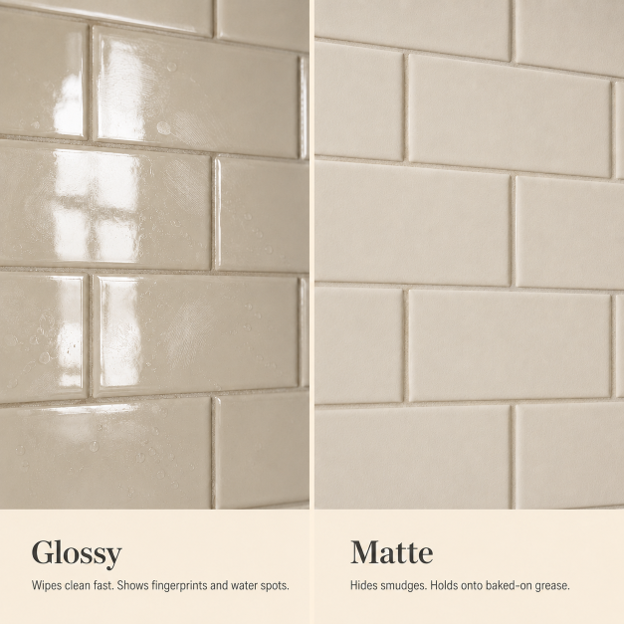
Behind a cooktop, finish is a practical decision as much as a visual one.
Glossy tile reflects light, which brightens the kitchen and makes it feel larger. It is also the easier finish to keep clean, because grease and splatter slide off the smooth surface with a quick wipe. The trade-off is that a glossy face shows fingerprints and water spots, so it wants a light wipe more often. Our Cloe and Marin collections lean into high gloss for that light-catching look.
Matte tile absorbs light for a softer, more grounded feel, and it hides everyday smudges and water marks well. The downside is that its fine surface texture holds onto sticky grease, so baked-on splatter behind a range takes more scrubbing than it would on a glossy tile. Our Makoto collection is a good example of a warm matte ceramic.
Beveled vs flat edges and crackle glazes
The edge profile changes the surface too. Beveled tiles have angled edges that add depth and cast small shadow lines, which suits traditional and transitional kitchens. Those angled crevices also collect grease and need more careful cleaning. Flat-edge tiles sit flush for a seamless, minimalist wall that is easy to wipe down, and they put the focus on the grout pattern.
Crackle-glaze tiles have fine cracks worked into the glaze for an antique look. Those cracks act like tiny channels, so oils, sauces, and even grout can seep in and stain the tile from within. A crackle tile has to be sealed before grouting and again after, and it should be kept away from acidic cleaners. Sealed properly, it holds up fine in a kitchen.
Best backsplash tile colors for 2026
White subway tile is not going anywhere, but the shade of white is shifting. The cool, blue-leaning whites of the 2010s are giving way to warmer, creamier tones that pair naturally with wood-grain cabinets and brass hardware. A textured, handmade-look white also keeps an all-white kitchen from feeling clinical.
Beyond white, green has moved to the front of the color conversation and overtaken gray as the go-to non-neutral, and deep blues and moody blacks are both popular for adding contrast. The right color depends heavily on your cabinets.
Backsplash direction | Cabinets it pairs with | Bedrosians options |
Warm, creamy whites | Wood grain, warm white, brass hardware | Makoto Shoji White, Zagora Blanc or Ivoire, Traditions Ice White |
Sage, olive, or forest green | White oak, walnut, matte black, warm white | Cloe Green |
Navy and deep blue-green | Crisp white, pale gray, brass, light maple | Cloe Blue or Baby Blue, Marin Ocean Teal |
Moody black | Natural wood, flat-panel white, stainless steel | Cloe Black, Makoto Kuroi Black |
Our Cloe collection alone comes in eight colors, from White and Creme through Baby Blue, Grey, Pink, Green, Blue, and Black, so you can go anywhere from a quiet neutral to a saturated statement wall.
Best grout color and type for a backsplash
Grout is easy to overlook, but it makes up a real share of the surface you see, and it is one of the strongest design levers you have.
Grout color sets the mood of the pattern:
Matched grout (white grout with white tile) nearly hides the grid for a soft, continuous look. This is the usual choice for zellige, where an invisible joint lets the tile's variation do the work.
Gray grout is a middle ground that softens the grid without disappearing.
Dark or contrasting grout outlines every tile for a graphic, defined look. It also hides dirt better than white over years of use.
Grout type decides how much upkeep the wall needs:
Grout type | Stain resistance | Sealing | Best for |
Cement | Porous, stains without care | Must seal and reseal | Lowest cost, if you keep up with sealing |
Epoxy | Non-porous and waterproof | Never needs sealing | The most durable, lowest-maintenance wall |
Urethane | Better than cement, flexible | Pre-mixed, no sealing | New builds and a low-fuss middle option |
Epoxy grout is the most resilient choice for a kitchen because it never absorbs stains and wipes clean, though it costs more and demands a skilled installer, since it cures fast and is nearly impossible to remove once it hardens on the tile face. Cement grout is the most affordable but has to be sealed and resealed to stay clean. Urethane sits in between and resists cracking as a new home settles.
Best subway tile patterns for a kitchen backsplash

The same tile can be read as traditional, contemporary, or bold depending on how it is laid.
Running bond (offset). The classic brick pattern, with each row shifted halfway. It flows horizontally, widens the room, and forgives minor wall imperfections, which makes it the safest all-around choice.
Vertical stack. Tiles stacked straight up in aligned columns. It draws the eye upward and adds a sense of height, which helps in kitchens with lower ceilings.
Stacked grid. Tiles aligned in a straight grid, all joints matching, for a clean, modern, architectural look.
Herringbone. Tiles set at an angle into an interlocking V, which adds movement and a high-end feel. It takes more planning and labor, and it wastes more material, roughly 15 to 20 percent versus about 10 percent for a running bond, so plan for the extra tile.
How much does a subway tile backsplash cost?
Material is the biggest lever on price. Ceramic and porcelain are the most accessible, while zellige and natural stone carry a premium for their handwork and rarity. The ranges below are general market estimates for the tile itself, not Bedrosians pricing, and they will vary with the specific product and your region.
Material | Typical material cost per square foot (general estimate) |
Glazed ceramic | $4 to $15 |
Porcelain | $2 to $15 |
Natural stone | $7 to $45 and up |
Zellige and handmade | $20 to $60 and up |
Professional installation typically adds $5 to $20 per square foot, and it climbs toward the top of that range for harder-to-cut porcelain, intricate patterns like herringbone, epoxy grout, and any wall that needs to be repaired or flattened first.

Because our subway and brick collections are designed in-house, they land at an affordable-luxury price for the designer look they deliver.
Bedrosians subway and brick collections for your backsplash
Once you know your direction, here are the in-house collections we would point you to. Each is designed by our team, which is how we keep a designer look at an affordable-luxury price.
Collection | Format | Finish and look | Best for |
Traditions | 3×6 | Glossy or matte, including Ice White gloss | The classic white subway look |
Chateau | 4×8 | Soft, handmade-look glazes | A larger classic with artisan character |
Cloe | 2.5×8 glossy ceramic (also 5×5) | Glossy, eight colors | Color and a modern, elongated shape |
Marin | 2.5×10 glossy ceramic | Glossy, colors like Ocean Teal | A longer glossy tile with saturated color |
Makoto | 2.5×10 ceramic | Matte, warm tones like Shoji White and Kuroi Black | A soft, light-absorbing backdrop |
Sahara | 3×12 matte porcelain (plus mosaics) | Matte, warm tones like Cotto | Large-format porcelain in a minimalist look |
Zagora | 2×6 and 4×4 zellige | Glossy glazed terracotta, Blanc and Ivoire | Authentic Moroccan handmade character |
Designers reach for these in real kitchens. Chris and Julia Marcum of Chris Loves Julia used our Cloe collection in a kitchen with a custom tiled range hood, and Nicole Salceda of Eye for Pretty used Zagora zellige in Blanc on a recent project. If you want to see the full range of shapes, our subway tile and kitchen backsplash collections are the place to start.
How to choose your backsplash tile with confidence
The title is hard to judge on a screen. Gloss, matte texture, and the shade variation in zellige all read differently in your own light, so it helps to get the tile in front of you before you order a full kitchen's worth.
Order samples. You can order $1 samples, or get five free with code SHIPFREE5 on a first sample order, and hold your top picks against your cabinets and counters.
Preview it in your kitchen. Our online Room Visualizer lets you see a tile on your own walls before you buy.
See it in person. With 44 showrooms across 11 states, you can view large display panels in real lighting and talk through format, finish, grout, and layout with a design specialist.
Frequently asked questions
What size subway tile is best for a small kitchen? A slightly elongated small tile, such as a 2.5×8, tends to work best, because the longer horizontal line makes the wall feel wider. A classic 3×6 is also a safe fit. Very large formats can overwhelm a small wall.
Is glossy or matte subway tile better behind a stove? Glossy is easier to wipe grease and splatter off and reflects more light, but it shows fingerprints and water spots. Matte hides smudges but takes more effort to clean baked-on grease. Both work, so it comes down to the look you want and how much wiping you are willing to do.
Do you have to seal a subway tile backsplash? Glazed ceramic and porcelain do not need sealing. Natural stone, zellige, and crackle-glaze tiles do, and zellige and crackle glazes should be sealed before grouting to protect the surface.
Find your backsplash tile
Ready to choose? Order $1 samples or grab five free with code SHIPFREE5, preview your favorites in your own kitchen with our Room Visualizer, or stop by one of our 44 showrooms across 11 states to see the tile in real light. If you would like help narrowing it down, reach out to us at (559) 275-5000 or info@bedrosians.com, and one of our design specialists will help you find the right subway tile for your kitchen.

